I’ve begun a music blog called Needle on Vinyl! Check out the most recent post: a brief look at the video for People Help the People, by Birdy!
Sun-drenched, charcoal shades of black and white adorn the video for the song “People Help the People,” but the true revelation of the video is the way it pairs transcendent music with such stunning images of urban life and its people. The song is a call for compassion between all communities, and a ballad of universal love and solidarity.
A couple weeks after Macklemore won the Grammy Award for Best Rap Album earlier this year, a number of old friends I grew up with and I launched into a fiery debate on Facebook regarding the song “Same Love”. The song and its video, which emerged as one of the popular Seattle rapper’s most socially-conscious and politically significant offerings, spread virally following its release in 2012. With lyrics openly supportive of same-sex couples’ right to marry, Macklemore simultaneously paints a portrait of a man struggling with his own sexuality and tussling with the stereotypes and stigma associated with homosexuality.
For those who don’t know, Macklemore is a prominent white rapper who, like Eminem, very quickly ascended the ranks of popularity and success in the hip-hop genre. “Same Love” was a song created explicitly to express support for the right for same-sex couples to marry. Today, gay marriage is slowly but surely becoming a reality in more states.
Significantly, the song includes heavy criticism of the reluctance in religious circles to embrace the gay rights movement. I remember first hearing the song and watching the video, and I remember how it made me feel. The song brought me to tears. Anchored by Mary Lambert’s soothing refrain- “My love, my love, my love, it keeps me warm,” the song is organic and warmly textured, with gentle piano reined in by strings, horns, and an upbeat drum track.
I remember sharing it in my feed, and commenting at the time that this, to me, was an example of modern hip-hop at its most resonant and emotionally poignant, not to mention politically significant. It brings modern conservative Christianity directly into its crosshairs, saying firmly and directly it is wrong to preach hatred and stigmatize those who identify as lesbian, gay, bi, trans, or queer. Macklemore raps:
“When I was at church they taught me something else
If you preach hate at the service, those words aren’t anointed
That holy water that you soak in has been poisoned
When everyone else is more comfortable remaining voiceless
rather than fighting for humans that have had their rights stolen.
I might not be the same but that’s not important.
No freedom til we’re equal… damn right I support it.”
In the months following this, a variation on the song emerged from the upstart Detroit rapper Angel Haze. Also called “Same Love”, the song has the same chorus and loosely, the same song structure, but with lyrics intentionally altered to reflect the point of view of a person who had experienced the struggle for gay rights from the perspective of the oppressed. Several of my friends claimed vociferously that Angel Haze’s song was the stronger and more significant piece.
Angel Haze identifies herself as pan-sexual, meaning, in her words, that she conceives of love as a concept that transcends physical differences and lines of gender identification. “Love is boundary-less,” she said in an interview with British newspaper The Guardian, “If you can make me feel, if you can make me laugh – and that’s hard – then I can be with you.” Her version of the song describes the rejection she faced from her mother upon coming out of the closet, and the ensuing suffering inflicted upon her by a parent who was neither understanding nor accepting. Like Macklemore, her voice is anchored by Lambert’s refrain- “I can’t change, even if I tried, even if I wanted to.” Angel Haze rejects “every single hand that chooses” and asserts that love is central, and that love is not something to be treated, transformed, or controlled regardless of what shape or form it may take. Her song is about self-acceptance on your own terms, regardless of the scars you might be tending to or the crosses you might bear.
While I identify as heterosexual (or ‘straight’, as we tend to say), I sympathize strongly with the gay rights movement and try to the best of my ability to do my part, as an ally, as often and as consistently as I can in my daily life. This is not by any means an easy position to take, seeing that our culture has for so long placed such powerful stigma and negative association upon homosexuality, queerness and transexuality, or even upon the intimation that one might associate, sympathize, or experiment with these identities. I strive to believe in the Kinsey-an concept that sexuality falls on a spectrum, and that these labels we place on ourselves, including those I place on myself, have very little real value except to box in and pin down our conception of sexuality, as though it were a butterfly that could be described scientifically, named, and classified. My own sexuality is anything but simple or one-dimensional, and I doubt that it is for anyone, regardless of their identification.
I found myself thinking about the two versions of “Same Love” last night, as I sat in a coffeeshop in Dupont Circle, here in Washington D.C. It’s a spot well-known for its nightlife, for the presence of an active lobbying voice, and for its openness and acceptance of people who identify as LGBTQ through yearly events in the neighborhood. Though I am a relative newcomer to serious analysis of hip-hop, I do try to keep up with the rappers who become celebrated and prominent, and particularly with those who write songs that offer meaningful commentary on issues of social, civil, and political import.
To my mind, Macklemore’s song was a statement of solidarity with and affirmation of the movement to achieve widespread acceptance and approval for the rights of same-sex couples in the United States. To others, and particularly to those who can legitimately claim to represent the voice of the oppressed communities, the song came across as the imposition of an outsider, and that Macklemore was undeserving of one of the most prestigious awards in the music business. That he was just another straight, cis, white, male appropriating the culture of a marginalized community whose struggles and experience he could not have possibly understood. What’s more, they argued that he was profiting from his stance, and that he was unworthy of the prestige associated with the award.
But for me, Macklemore’s song was equal in importance to Angel Haze’s, if not even more inspiring, considering my particular relationship to the issue. To hear a white, straight male show support and “come out,” unequivocally and inspiringly, as an ally and supporter of gay rights, in spite of the struggle it took him to reach that place, gives me the courage to raise my voice in support of my friends and loved ones I care for who identify themselves in that way. It gives me the will to be vocal and persistent in my allyship, and to speak up when I see my gay and lesbian friends marginalized, abused, dismissed, or disregarded. And ultimately, I think Macklemore’s statement is interwoven with that of Angel Haze, who speaks of a reality I prefer to embrace. She is rapping about a world where labeling and arbitrary division is irrelevant in the face of a love that overwhelms fragmentation, whether it be along racial, class, or sexual lines. She put it best in her lyrics:
“No I’m not gay.
No I’m not straight.
And I sure as hell am not bisexual.
Dammit I am whoever I am when I am it
Loving whoever you are when the stars shine and whoever you’ll be when the sun rise.”
What’s more, I think that the faith community needs to recognize that acceptance and inclusiveness to the broader LGBTQ community is integral to success in the 21st century. As long as Christianity is associated with images of hellfire and damnation for those we arbitrarily consider “sinners,” the church is going to lose more and more young people. Forward-thinking denominations today actively minister to LGBTQ issues, and I personally would like to see this trend spread to the evangelical community and to the more orthodox circles of other religious communities, and particularly to more synagogues and mosques.
Today I am lobbying the office of Representative John Lewis, the civil rights hero and staunchly progressive legislator from my home, Atlanta, the cradle of the civil rights movement. I am so lucky to have this opportunity to make my voice heard to an American hero, who displays the audacity and integrity to stand up for the rights of the oppressed, even when his actions put himself and his fellows at risk. Just as Congressman Lewis made a stand for the sake of future generations in the 1960s, so will it take the voices of brave souls like Angel Haze and allies, like Macklemore, to achieve equality and justice for the LGBTQ community, and for other oppressed communities.
It is patently wrong to preach hate, and I, for one, will no longer stand for it. To me, that is what it means to be an ally, and to live out this definition today. The music of brave artists like Macklemore and Angel Haze should inspire us, in our efforts at civic engagement and positive contribution to political society, to create the world we want to live in, no matter our background or orientation.
I have walked your streets. I have seen the splashes of colorful graffiti adorning your walls and I have languished in the torturous and disorienting trudge of your traffic. I’ve talked to folks in the red-clay streets of the southern suburb of Clarkston, just outside the perimeter, where the American Dream towers from afar like something shining and new. And I’ve talked to folks arcing their necks to see the skyscrapers up and down Peachtree Street, looming and beckoning like some futuristic metropolis. I have walked down the central drag, admired the towers and sculptures and the worlds of fantastical art and culture within this city, products of the human imagination contained in each of us.
I don’t understand you, Atlanta, but I appreciate you, in all your honesty and brutality, bless your heart.
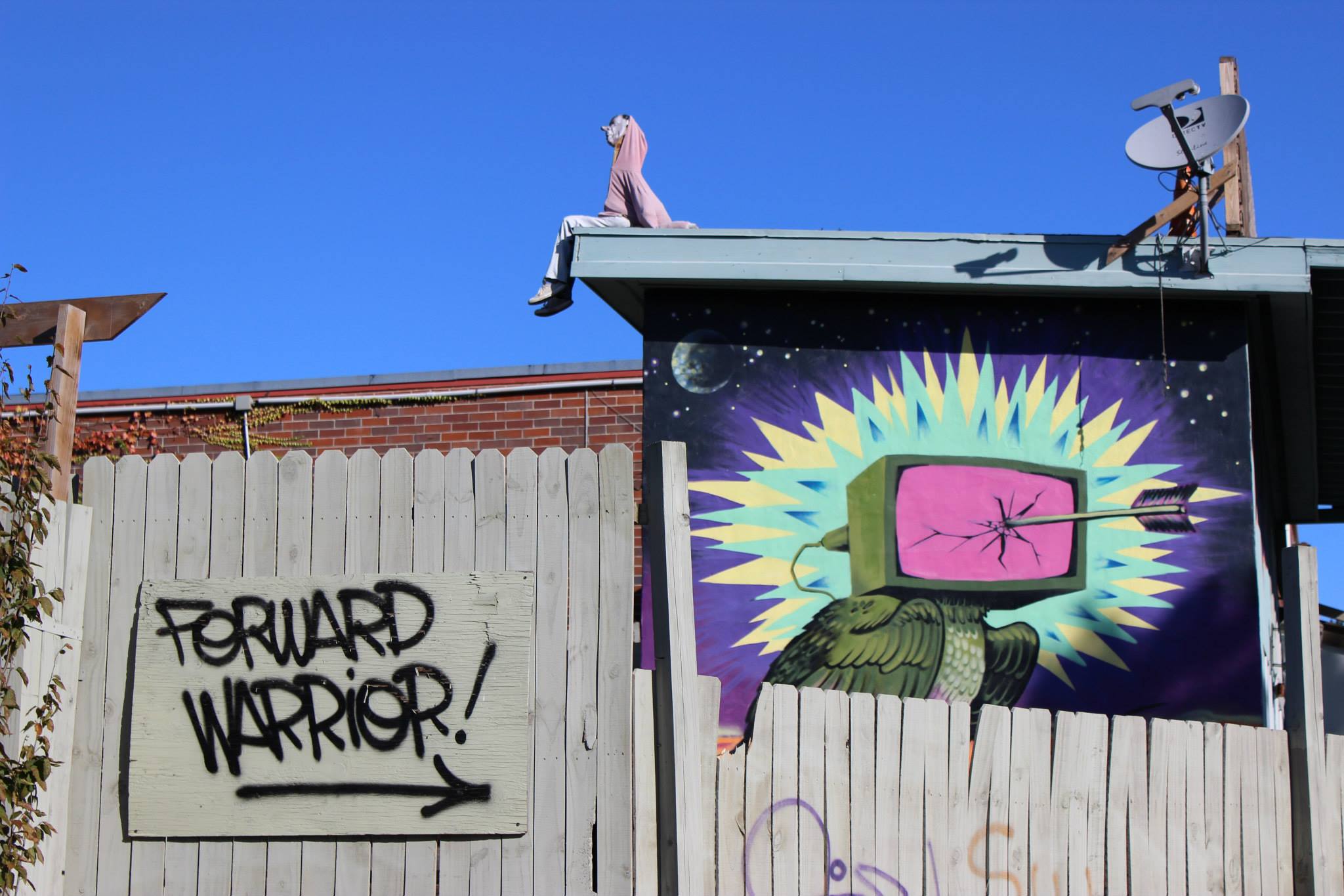
A piece of public art seen along the Atlanta Beltline, a recent municipal project here.
This city is more than a little bit sneaky and subversive. The coolest spots are sometimes tucked away, behind (quite literal) trick bookcases and hardly recognizable side alleys. There seem to be decrepit streets emerging in every direction, but they are speckled with commercial projects“being worked-on” and lovingly imagined but yet to be realized city markets (one on Krog street, one on Ponce de Leon), which color my neighborhood with an expectant aura, a buzzing energy and incipient, burgeoning potential for growth. There is a dedicated ’20s club dressed up like a speakeasy, a cavernous Paris on Ponce antiques store lined with curious oddities and remarkable trinkets, and underground clubs with names like MJQ, and The Graveyard, where the drinks flow like water and the dancing is unbelievable.
It was here that I re-earned for myself the confidence that I have something in me that is valuable and precious. It is here that I reignited the hope and inspiration in me to write for a living. I found warmth and comfort and acceptance here from people who, like me, were searching for a way to live with meaning in the world. In the year-long volunteer program I was a part of, I found camaraderie with other young people engaged in the same struggle I was. Having all recently left college, we, like so many others, were all faced with the imposing question: “What now?” And now, well into my life on the other side of that experience, I continue to face that same burning question.
After the volunteer program, I was suddenly thrust back into the job search, and I picked up the first promising job I could line up for myself, at a community newspaper, and worked my ass off for them, but this project didn’t work out for me in the end. A couple friends and I had settled into a new intentional community with each other, and set up a foothold for ourselves in a new neighborhood. We helped each other get on our feet, and through the transition into new jobs and new roles. Some stayed with their organizations, others moved home, and a few of us stuck it out in Atlanta. I still see and talk with them all the time, and they remind me of good times.
But now, I am working in the heart of the city, observing it from the inside out, as a valet in a hotel here. It was so strange to go from the outskirts to the interior, and to see the city through the opposite lens. Where before I would write stories of struggling, hard-bitten entrepreneurs, new Americans and former refugees for my non-profit organization, I was now writing for myself only, and solely when I had the chance between shifts of parking cars.
I work long hours, and living off tips is thrilling but unpredictable, and I find it difficult to find time to devote to my life’s passion. This is a shared state of affairs for many if not most mid-twenties millennials. We are an under-employed, over-worked, tweaked-out, tech-addicted, narcissistic generation, but give us some credit. We were mostly raised by our iPods, after all.
Here in Atlanta at least, we young people breathe in and out a spirit of reckless agitation and righteous fury, touched with a glimmer of edgy self-expression and provocative invention. There are arts festivals and parades nearly every weekend throughout the summer, scattered among Atlanta’s many neighborhoods. We are just as likely to be celebrating through the weekend as we are to be working hard at our regularly-scheduled jobs during the week. There are more than enough fantastic concerts in the pages of Creative Loafing than I could ever scratch the surface of, especially on a volunteer’s budget. Every other person is an aspiring musician, poet, or artist on the side. Our generation of movies, like Frances Ha, explore the neuroses and ambitions of our generation, and paint engrossing portraits of lost artistic souls just trying to make it in the city (a timeless tale.) This story is the prevailing story of the emerging adults of the new millennium.
A rose in front of a house in Old Fourth Ward, my neighborhood in Atlanta.
And after all, why not? This is, after all, the hotbed of the Civil Rights movement, where young people struggled and fought to redefine the old boundaries of a dated society, and actively, mostly non-violently, challenged the prevailing prejudices of America. Atlanta, you have been my friend in the midst of these torturous twenties, where nothing can be taken for granted and the future is a big neon-colored UNKNOWN. Your confusion mirrors mine, and your extremes match my own, the pulse of which I am becoming more familiar with every day. Atlanta, you bleed extreme joy, extreme anguish, personality, and a deep, almost religious fervor and spirit. You are as grounded as the cold pavement of your streets, if sometimes a little bit fumbling and polite.
I am glad to be here, in the urban capital of the South, and I am glad to have learned from and with you, through the Snowpocalypse, and the most recent election, and the emergence of Breaking Bad and Game of Thrones as national obsessions. I was here for the National Championship in the Georgia Dome, and I saw Muse and Sting and Dave Matthews perform in Centennial park. I mourned with my colleagues during Sandy Hook, and I watched with horror on the day of the Bostan Marathon bombing. I have searched for jobs here, and I have searched for houses here, and I have explored your coffeeshops and restaurants. I am so lucky to have found myself here. Atlanta, you have been a difficult friend, but the kind that is endlessly rewarding to know. And I’ve enjoyed spending this piece of my twenties with you.
Anyway, that’s all I really felt like saying. I hope you’re ready! Spring is here! It’s pollen season. The leaves are coming back. Let’s enjoy this warm weather, and celebrate the fact that we are alive and young, and that our future awaits us, and that really, truly, anything CAN happen, and here in Atlanta, it probably will.
In the two years of restaurant work following senior year, and extending in my life far before that, music has been such an important source of strength for me. It has sustained me and awakened me, and it has piqued my intellectual curiosity and comforted my pain. It has been my guardian angel.
Throughout four years of college, I never my quit my shift as a rotation DJ at the local radio station. This entailed extremely late hours, little recognition, and long walks in the snowy Kansas winter to reach the Shack, a ramshackle building at an obscure corner of campus. I would delve myself deeply into a nearly endless library of music, playing them over the studio speakers at as high volume as I could muster without shattering my eardrums.
As a rotation DJ, I had access to the entirety of KJHK’s stacks and stacks of music, both CDs and vinyl, not to mention our own music or the nearly-unlimited selection we could stream through the station’s computer. I would watch my view of the sunrise from the tiny window of the DJ booth overlooking downtown Lawrence, down the western side of Mt. Oread. I would toil through late nights between the hours of 2 and 6 am, spending hours weaving songs into and out of each other, one after the other, and keeping my eye out for the flashing white light that meant I was receiving a listener’s call. It was overwhelming at times, and I am sure that my tracks sometimes did not flow as well as I would have liked. But it was a necessary and enriching escape for me from the intensity of college life, and I occasionally would receive a call from listeners who appreciated my music selection. It felt good to accompany the occasional early-morning runner, or late-night lonely soul, with good beats and a voice on the other line.
I delved into endless catalogues of various and indescribable music, plunging into the depths of the shelf devoted to electronica, and even occasionally flirted with the stacks of metal. Always, I was aided by the words of DJs who had come before me. They used to write reviews of every album the station would receive, and tape them to the front of the CD’s jewel case, accompanied by star ratings and personal opinions. Someone, at some point in the station’s history, had listened to and reviewed every album there, and they could provide hints and clues as to which songs would rock the hardest or jam out the most.
And when things in my life became challenging, as they often did, I found it was the music that inevitably pulled me through.
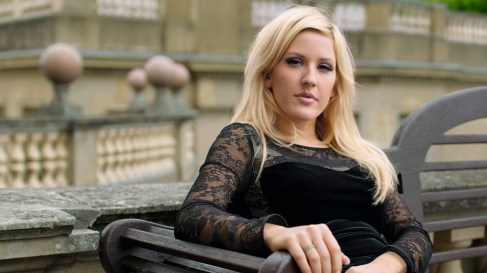
But after the Shack was replaced by a modern, state-of-the-art studio towards the end of my senior year, and I DJ’ed my final rotation show, I said farewell to my beloved KJHK and returned to the real world. As a dishwasher in a restaurant, music kept me company while working 8-hour shifts, and my fellow restaurant workers had a great collection. You can always expect to hear the best music from the speakers of a bustling restaurant kitchen, where the energy and tempo of the music is the best company you keep while chopping vegetables, picking basil, or manning the industrial dishwasher. It was songs like these, and songs like Lights, by Ellie Goulding, that spoke to me most deeply, and kept me sane during that time.
Lights is shimmering, pulsing, and sensual. It is about the call of city lights, the itch to be alive, and the urge to dance, laugh and cry. Ellie expresses the sensitivity and fear that it takes to move to a new place, and to build for yourself something brand new, with people you have just met, and to seek love and joy, while embracing your flaws. Her lyrics of “turning to stone” speak of a vibrant soul calming her firing nerves, picking up the pieces of her shattered self, and mustering the courage to fight on.
In my two years at the restaurant, it became clear to me that I couldn’t stay there forever. I knew that this wasn’t the work for me. I knew that this wasn’t my dream. I knew that there was so much more to see and to do in the world. I felt, in the depth of my soul, the passion and call to follow my dream and reach out for what the world has to offer. And it was Ellie Goulding that became the soundtrack of the months leading up to my eventual move to Atlanta. Just as the lights were calling her, in the song, the lights of Atlanta were calling to me.
If it is music is that kept me going through my darkest moments, both before and after college, it is music that will carry me into the future.
Now here I am, working in Midtown, across the street from the historic Fox theater. I am going to see Ellie Goulding perform there in exactly one month. Her light show, her reverberating sound, the texture and depth of her voice, and the cheering crowds await me.
Artists like Ms. Goulding, who inspire and guide us young people, deserve to be celebrated. We owe them our lives. Keep doing what you’re doing. Keep tinkering in the lab at night, keep writing your raps and sonnets, and keep weaving melody and harmony and instrumentation and beats and effects. Do it for us. We love you.
The day that Philip Seymour Hoffman died, I was browsing devices in a Verizon Wireless store. I picked up a random tablet and the first thing that popped into my view was the headline on a news app. Hoffman’s face stared out at me from the glowing screen of the device. “PHILLIP SEYMOUR HOFFMAN HAS PASSED,” it read. Something snapped inside me. I nearly dropped the tablet.
He was found in his hotel room, surrounded by little bags of heroin with the images of playing cards printed on the outside of them. I never even knew that he had been struggling with drug addiction, and it destroys me inside that someone so accomplished, by all outward appearances, could be tortured in this way. It is horrible to see such a talented performer pass at the hands of the hovering specter that is drug addiction.
It is always a shock when one of your idols dies. But when they die alone in their hotel room, a needle in their arm, surrounded by little envelopes labeled with images of the Ace of Spades, it becomes so much worse. And I could barely make myself read more deeply into what happened.
I know he relapsed. And I know that he overdosed. And that is all I want to know.
The man was well-respected by nearly everyone I spoke to, and to serious movie fans he was a household name. He took on the difficult roles; the understated, supporting roles that others wouldn’t. Seeing him inThe Big Lebowski, of course, made me smile, because that has always been among my favorite films. And his appearance in the newHunger Gamesmovie was a good break for him into the mainstream (I have no idea how they could hope to replace him.) But his real genius lay in lesser-known, more challenging films, such as Doubt and The Master. Here, I am going to focus in one in particular… the classic for which he won the Academy Award for Best Actor in 2005, Capote.
Phillip Seymour Hoffman starred in the movie “Capote”, for which he won Best Actor in 2005.
Capote was the story of the accomplished novelist Truman Capote, who decides to write a true-to-life biography/true crime novel about a pair of grisly murders in rural Kansas. In the process of writing it, Capote struggled with the line between author and subject, and the difficult ethical questions presented by an artist’s attempt to mix reality with fiction techniques in his writing. Hoffman’s portrayal cast a vivid impression of a man of ambition, a gifted writer, and a flamboyant socialite, who became obsessed and deeply involved in the lives of a pair of troubled murderers, and in particular, with the kindred spirit of Perry Smith.
As much as Hoffman was a hero of mine in the world of film, so was Capote a hero of mine in the world of writing. He could draw you in, shock you, fill you with wonder, and transport you with the depth and poignancy of his writing. But when the techniques of fiction blur with the outcomes experienced by real people as a result of a piece of writing, and suddenly lives are on the line, quality fiction just doesn’t cut it. Trenchant reporting, and world-changing writing, must be grounded in a solid understanding of ethics, intentionality, responsibility, and dare I say, consequences. In deepening his relationship with Perry Smith and providing the doomed man and his partner in crime with hope that he could not ultimately fulfill, Capote overstepped the bounds of a responsible writer.
Hoffman’s portrayal of Capote was flourishing, nuanced, and ultimately brilliant. He showed a man losing himself to the struggle of what good gonzo writing really is and should be: significant and reflective of reality, while at the same time fascinating, mind-bending and addictive. Capote knew all along that In Cold Blood would be a classic in the canon of modern literature. But the book nearly killed him, and while it is acknowledged as a masterpiece of its genre, it would turn out to be his last book published in full.
Phillip Seymour Hoffman embraced the roles that dismiss the simplicity and shallowness of black-and-white ethics. The great performances of his career reflect a reality that is beyond good and evil, right and wrong, happy and sad. He tussled with the fullness of reality, the world where things are not what they seem and stories don’t always end with the heroes living happily ever after. He tussled with complexity. And he lived the life of an artist, giving us the gift of consistently stellar performances throughout his life.
But his true legacy, which will certainly be colored by the ignominious circumstance of his death, will be the face and voice of the strange and challenging minority. He was not like the others. If there was one thing that Phillip Seymour Hoffman wasn’t, it was one-dimensional. And perhaps that is part of what tortured him so, and repeatedly led him to the false comfort of hard drugs. He was an outlier, an idiosyncratic face and voice that would be impossible to pin down, and a consistently brilliant actor.
Its music video is spare; minimalist; monochromatic; almost anemic. It is a teen drama unfolding obscurely, from the depths of emptiness at the heart of faceless suburbia. Grounded by a solemn, pounding drumbeat that feels as inexorable and imposing as a beating heart, the song itself is repetitive and catchy, like good pop music should be. Layered vocal tracks and pulsing bass lift the arrangement beyond the realm of the ordinary, and it is no wonder the song Royals is such a hit. The song holds the longest reign at No. 1 on the billboard charts for alternative songs, by a female artist. But there is something more going on. Why is every face you see in this video white? What is with those lyrics, so openly critiquing popular hip-hop? What… exactly… is happening here?
… every song’s like gold teeth, grey goose, trippin’ in the bathroom Blood stains, ball gowns, trashin’ the hotel room, We don’t care, we’re driving Cadillacs in our dreams. But everybody’s like Cristal, Maybach, diamonds on your time piece. Jet planes, islands, tigers on a gold leash. We don’t care, we aren’t caught up in your love affair.
From the first line of Royals, Lorde sets up her song as a commentary on wealth and its pursuit. “I’ve never seen a diamond in the flesh,” she sings, as she transfixes the camera, and the viewer, with a sweet, venomous and icily subversive blue-eyed glare. Such sweet irony that she speaks of jewelry “in the flesh” as though diamonds were organic, and wedding rings were something to cut your teeth on. As though “ice” could buy success. As though jet planes, islands or tigers on a gold leash could fill an empty, twin-sized bed. As though alcohol, like Grey Goose or Cristal, or a lifestyle of ‘trashing the hotel room,’ were telling of a glamorous and luxurious life well-lived.
As early as the first verse, Lorde rattles off a list of black celebrity cultural touchstones in the music industry. Gold teeth, Cadillacs, Maybach… these bring to mind a kind of wealth and luxury that are decidedly.. not-white. These are phrases and references that bring to mind Lil’ Wayne, the Dirty South rap movement, Rick Ross, Mike Tyson in “The Hangover…” in other words, mainstream, primarily straight black male, hip-hop culture. A culture that is loud, expressive, aggressive and colorful…. even, at times, intentionally boastful about violence and often unapologetically misogynist, sexist, and homophobic.
Lorde, a 16-year old musical artist from New Zealand, skyrocketed to international fame and renown in late 2013 on the basis of a hit song that directly calls to account the very same hip-hop culture that produced Kanye West, who in his most recent album Yeezus, rapped lyrics as enlightening as “When a real nigga hold you down you supposed to drown” and “One good girl is worth a thousand bitches,” and Rick Ross, founder of the Maybach Music Group, who last year withdrew lyrics celebrating rapeand apologized publicly for them. Royals, since it came onto the scene, has since been remixed multiple times, including at least one instance with Rick Ross as a featured guest, and has received four nominations for Grammy awards, including for “Song of the Year” for Royals, and “Record of the Year” and “Best Vocal Pop Album” for Pure Heroine, her debut offering.
The song has received its share of criticism, including being labeled racist by prominent blogger Bayetti Veronica Flores on the website Feministing. Flores’ criticism of the song comes with the context of the difficult history of U.S. race relations, knowledge of which may not necessarily be a safe presumption for a young musician from New Zealand. But Flores’ most basic issue with Royals is that it is directly and openly hostile to hip-hop culture, and more specifically, to black cultural tropes. And that is accurate. What is more, anyone who has traveled can tell you that American pop culture crosses international boundaries, and any discussion of a song at this level of popularity can’t be limited only to its influence or airplay in the U.S., particularly since Lorde herself hails from overseas. If Royals is racist here, it is racist everywhere.
But dismissing the song as simply racist does not touch the full depth of the song. I would argue that Royals, and itscompanion music video, when taken together, represent a broad critique of the mainstream and primarily American culture of wealth acquisition, masculinity, and their interconnected relationship with issues of racial identity.
The video is a series of images of young white men… thin, muscular, with short brown, red, and blonde hair, white T-shirts and shorts, standing, boxing, and relaxing in an empty, unadorned suburban home, with pale tan curtains and stark geometric lines. The young men are seen eating cereal, boxing in their living room, staring hopelessly at the ceiling of a basketball court, submerged underwater in a swimming pool, and in one powerful image, laughing and bleeding from the mouth. They have the bodies of athletes, probably swimmers, and their imperfections are on display for the world to see: acne, tufts of shaved brown hair falling to the floor when they shave, a close up of an adolescent Adam’s apple. While the song itself openly rejects tropes of black culture and proclaims proudly that “We’ll never be royals,” the video methodically constructs a stripped-down image of white masculinity.
And throughout it all, we are shown the eyes and voice of Lorde, an unmistakable smile hovering behind her unreadable eyes. She blinks her heavily mascara’d eyes, adjusts her mess of curly hair, visually daring you to question her. She strikes an unreadable, but unmistakably subversive, intelligent demeanor.
The song, to my mind, is less about deconstructing expectations and dreams of people identifying themselves as part of a particular race, than it is about deconstructing expectations and dreams of everyone. We all, white or black, male or female, dream about diamonds, fancy cars, parties, and the intrinsic feeling of royalty and privilege that we associate with wealth and material success. To say the song is all about race, is to miss the point entirely. The song is about wealth, pop culture, and the difficult relationship that average, hardworking people have with the constant media barrage of decadence and material excess.
Mainstream pop music has pretty recently released a number of songs asserting and rejoicing in the trappings of youth, “We Are Young,” by Janelle Monae, being a prime example of this. For the most part, these songs celebrate the enjoyment and glory of a life of wealth and excess, partying and drinking and knowing that, after all, You Only Live Once. But Royals has a distinctly different agenda.With this song, Lorde is making the case for a new kind of love, “a different kind of buzz,” a kind of youthful ethos where money, wealth, and alcohol are secondary. The young men in the video of Royals are not in it for the money. Their television displays only static. In their alienation from the decadent pulse of mainstream American culture, these young men display a grounding and motivation that come from within, from each other, and not from the diamonds and dollar bills that characterize material success.
Towards the end of the video, there is a shot of one of the young men riding on the train. His head leaning against the cold window, the man, who is hardly an adult, watches out the window as the world passes by him. The image visually mirrors a scene toward the end of the movie “Crash,” from 2004 (nearly ten years ago). The film, an extended meditation on race relations in urban Los Angeles, won the Academy Award for Best Picture. Towards the end, the character played by Chris “Ludacris” Bridges leaned his head against the window of a bus, public transportation he had sworn he would never use, because, to his mind, the system of public transportation is part and parcel of instutionalized racism in urban America.
Screenshot pulled from the video for Royals, by Lorde, released in 2013 by Universal Music.
In both scenes, lost young men, both presumably from backgrounds of poverty, find themselves on the periphery of mainstream society. The cold glass of the bus window symbolically separates them from a cold exterior world, a world of rough black pavement, cold steel automobiles, and the grinding pursuit of wealth. Houses and buldings pass them by in a blur, and they wonder what it means to come of age, and accept the mantle of an adult male in a capitalistic, wealth-driven society. What does it mean to be successful? Can money bring us happiness? What is this “love” thing everyone keeps talking about? Am I going to be ok? Who do I want to be? What kind of a person am I? What sort of future do I want to create for my children? These are universally difficult questions, for adults of every race, and to my mind, every gender.
This is a song about the pursuit of happiness. This is a song about finding meaning in a media-drenched world whose songs and movies reflect an idealized worldview that doesn’t necessarily match with bitter reality. This is a song about learning who we are, and learning to feel comfortable being ourselves. This is a song about coming of age.
I couldn’t speak to whether Lorde could be considered a feminist, and I couldn’t say whether Royals is, in fact, racist. But I think that Lorde, at the tender age of 16, has produced a piece of art that effectively challenges and questions the importance we place on wealth in Western society. I think the song, and the video, are attempting to critique the pulse and tenor of modern pop music. And, in my personal opinion, I think the song and artist deserve every bit of renown they have received.
I am blown away by Wonky Haus, and the world I have found myself with, and the people that I find myself with. I love this place so much, and I can’t even describe how lucky I am to be here. Wonky Haus is a place where you can feel enthusiastic about life, and intrigued about the possibilities of creative expression and pursuit, and not feel like you are the exception to the rule, or that you are betraying some unspoken rule, or that you must project your superiority at all times. I don’t feel self-conscious here, and that is a gift that cannot be measured. It is a new year, and I felt obliged to reflect on this. Happy New Year!!!
This Thanksgiving, I was fortunate enough to travel north to Chicago and visit my family in the suburbs of Evanston and Skokie. The northern suburbs of Chicago were beautiful but the weather was bitter cold. It was a day-long, shotgun, last-minute journey, one that I barely managed to schedule with Spirit Airlines when a pair of other bookings fell through. I literally was not sure until the very last moment that I was going to make it. But I did, and it was so worth it.
In the air between Dallas and Georgia
As I was in the air over Dallas, I looked down at the earth below me. “What magic,” I thought to myself. What a miracle that we simply spend $300-$400 dollars, and suddenly have access to any place in the continental U.S. We live in an age of miracles, and we often forget that, I thought to myself, as I looked down at the fields and highways far below me.
Unfortunately, my time with the community newspaper in Clarkston has ended, and I had to seek other work. I learned a lot from my time with The Broadway, and I put my all into it, speaking to some fascinating people and cementing my love and respect for the people of Clarkston. I was unemployed for a brief and miserable two weeks, but I finally found a position as a valet at a historic hotel in downtown Atlanta. It is an amazing and interesting job, and I am learning a lot about the hotel business and about life and urban economy. I work mostly for tips, and I park beautiful, marvelous cars for a living. I come home exhausted but satisfied from long but legitimate work.
It is not the dream job of meaningful writing that I am ultimately looking for, but it is life sustaining and it is comfortable and reliable. I am learning that the journey often contains surprises, and it is the best we can do to maintain an even emotional keel, and to keep a handle on what is most important: our relationship with our friends, family, and loved ones, and our habits of self-care and self-respect. As I looked down on the earth from 30,000 miles, I couldn’t help but thank God for my health, and my loving family in Chicago, and my community of friends here in Atlanta, the place I am coming to think of as my home.
As this October day drags on, I am enjoying the fact that this portfolio is still here! It’s been an eventful year. Quaker Voluntary Service wrapped up, and I said farewell to some dear, close friends. I am now settled into a new intentional community in Atlanta that we have taken to calling Wonky Haus.
I’ve been working for a community newspaper in Clarkston, a project that I feel very passionately about. I think I put my best into it, and who knows, maybe something will emerge in the future as a result of that hard work! But in the meantime I am searching the Atlanta area for an employer willing to pay a living wage for what I can offer.
View overlooking the Historic Old 4th Ward Park.
I enjoy writing, and I like to see that platforms which I establish for myself, generally are not erased as time passes. I will keep working at it, and I know that my efforts will blossom with consistent, nurturing care.
It’s been two and a half years, and it’s past time I attend to this site. I’m a Quaker Voluntary Service Fellow now, placed at the Clarkston Development Foundation, just outside Atlanta, as a Communications Associate. I have the opportunity to meet interesting people all the time, and I write for our newsletter about the things that I experience.
The transition to Atlanta was exciting, and the rush of the first few months here was overwhelming. It is good to be in the professional saddle again, and I’m looking to flesh out my portfolio and keep the streak alive.
As for tonight, I’m looking forward to some sweet potato latkes, and I can’t wait to watch game two of the World Series! 🙂







 Collected Works of Justin Leverett